
Reviewed by Shailaja Ramesh
You can speak clearly and keep your Indian English accent. If you’re wondering how to learn an English accent for interviews or work calls, start with the words listeners ask you to repeat. A change in stress, a clearer vowel or a short pause may be all they need.
IELTS Speaking also assesses how easy you are to understand. The official descriptions for bands 8 and 9 mention how much accent affects understanding, and the other bands also consider how clearly speech comes across. You can meet the criteria with an Indian English accent. Official IELTS Speaking band descriptors · STEP guide to the IELTS Speaking bands
What does mother tongue influence mean?
You may hear “mother tongue influence”, or MTI, in recruitment or training in India. People use the term for speech patterns that carry over from a language you learnt early into another language you speak. That can include the way you stress words, pronounce a sound or group words into phrases. India has many languages and many ways of speaking English, so the label tells you little about any one speaker.
Accent tells a listener something about the speech patterns you’ve heard and used. Skill at your job shows up in the work you do. If someone gives you feedback about your speech, ask for one example of a word or phrase they missed. That gives you a place to start.
Do you need a British or American accent?
Use the pronunciation that feels natural and that your listeners can follow. A dictionary’s British and American recordings give you useful reference points. For example, the British recording for schedule starts with a “sh” sound and the American one starts with “sk”. Both stress the first syllable. Cambridge audio for schedule
Courses advertised as accent training or accent neutralisation may cover sounds, stress and rhythm, or teach you to imitate a particular accent. If your goal is clearer client or interview calls, look for feedback on the situations where people miss what you say. A sample call can help you work out whether the useful change is a sound, your pace or the way you explain a detail.
Six pronunciation habits to practise
Start with one feature that matters in your conversations. The ✗ and ✓ examples show what can happen when a sound or stress obscures the intended word, and what to aim for in that situation.
1. Word stress in English
Give one syllable a little more time and make it stand out. Tap once on your desk when you reach it. Let the other syllables sound lighter.
- ✗ DE-vel-op
✓ de-VEL-op - ✗ HO-tel
✓ ho-TEL
Say “We’ll develop the idea at the hotel.” Try the two words on their own, then bring them back into the sentence. Cambridge audio for develop · Cambridge audio for hotel
2. The v and w sounds
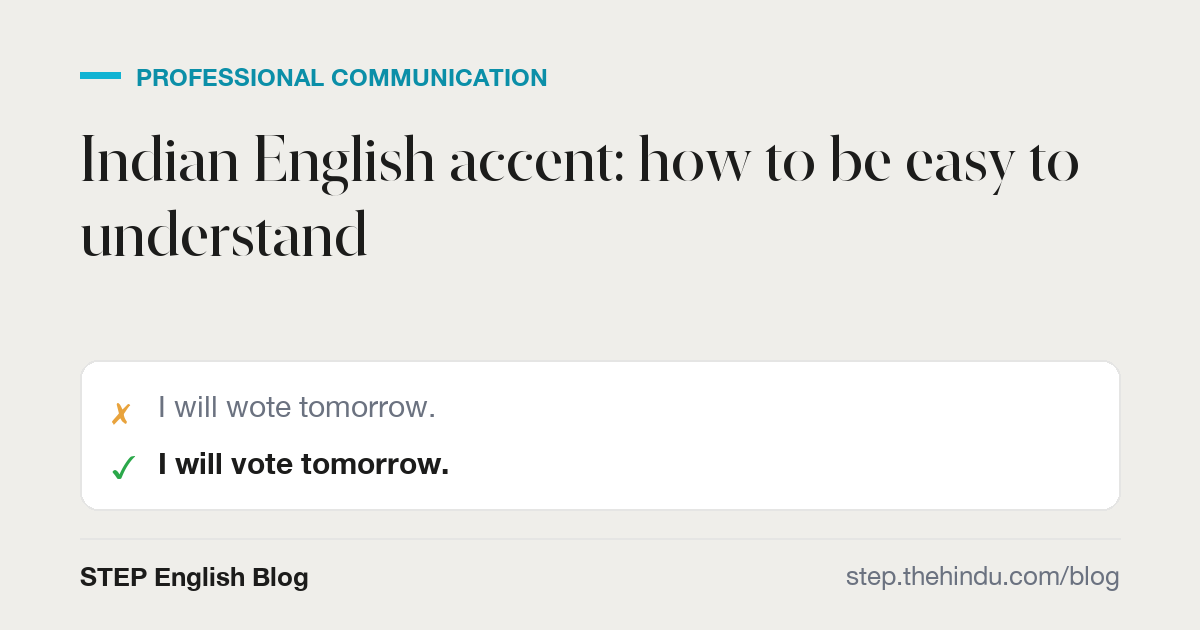
For v, let your upper teeth touch your lower lip lightly and let your voice and the air come through. For w, round your lips and move into the next vowel. Try vine and wine, starting each word slowly.
✗ “I’ll wote tomorrow.”
✓ “I’ll vote tomorrow.”
Say “We’ll vote on Wednesday.” Feel how your lips change when you go from we’ll to vote and back to the start of Wednesday. Cambridge audio for vote
3. The th sound in three
For the sound at the start of three, put the tip of your tongue lightly against or just between your front teeth. Let the air pass. Listen to what changes when you start tree with a quick t instead.
✗ “I ordered tree boxes.”
✓ “I ordered three boxes.”
Say the number on its own first. Then say “three boxes”, and finally say the full sentence at your normal speed. Cambridge audio for three · Cambridge audio for tree
4. Long and short vowels
Listen to ship and sheep, then full and fool. The vowel changes in both length and sound. Use the dictionary audio and copy each word before saying the pair back to back.
✗ “The sheep reached the port.”
✓ “The ship reached the port.”
Try “The bus is full” after practising full and fool. Say the words with their usual vowels even when you whisper them. Cambridge audio for ship · Cambridge audio for sheep
5. Speed and pausing
On calls, short pauses give the listener time to take in an idea. Put the pause where you would separate the ideas in writing. The slashes below show where you can pause.
✗ “The report is ready I’ll send it this afternoon please check the figures.” [Said in one rush.]
✓ “The report is ready. / I’ll send it this afternoon. / Please check the figures.”
Record the second version. Listen for a pause after ready and after afternoon. You can speak at your usual pace within each short part.
6. Extra vowels before s-clusters
In words such as school and space, the s leads straight into another consonant. Hold the s a little longer while you practise. Then move straight into k or p.
✗ “I’ll meet you at the ischool gate.”
✓ “I’ll meet you at the school gate.”
Try “sssschool”, then say school as you normally would. Do the same with space, then say “We need more space.” Cambridge audio for school · Cambridge audio for space
20 commonly mispronounced words to practise
The capital letters show the main stress. The cues are approximate. Open the dictionary links to hear each word, then try it in a phrase you use.
| Word | Say it with this stress | Try it in a phrase |
|---|---|---|
| Develop | de-VEL-op | develop a plan |
| Hotel | ho-TEL | book a hotel |
| Comfortable | COM-fuh-tuh-buhl | a comfortable chair |
| Vegetable | VEJ-tuh-buhl | vegetable curry |
| Photographer | pho-TOG-ra-pher | hire a photographer |
| Photography | pho-TOG-ra-phy | learn photography |
| Pronunciation | pruh-nun-see-AY-shun | check the pronunciation |
| Certificate | suh-TIF-ih-kuht | send the certificate |
| Available | a-VAIL-a-ble | available on Monday |
| Appointment | ap-POINT-ment | make an appointment |
| Colleague | COL-league | ask a colleague |
| Customer | CUS-tom-er | call the customer |
| Delivery | de-LIV-er-y | track the delivery |
| Receipt | rih-SEET | keep the receipt |
| Schedule | SCHED-ule | change the schedule |
| Technology | tech-NOL-o-gy | new technology |
| Career | ca-REER | start a career |
| Engineer | en-gi-NEER | speak to the engineer |
| Record | REK-ord as a noun, re-CORD as a verb | keep a record / record a call |
| Present | PREZ-uhnt as a noun, pre-ZENT as a verb | buy a present / present the findings |
Make names and numbers clear on calls
Slow down just before a name, amount or deadline. Say the number, say the unit and confirm the digits if there’s any room for confusion. For example, “Fifteen orders. That’s one-five. Can you confirm?” If a detail is important for the work, add it to the chat or the follow-up email.
Introduce yourself at the pace you want others to use when they say your name. If a listener asks for it again, give them a moment and spell it if needed. When someone introduces themselves, you can ask them to say their name again and repeat it back.
If someone comments on your accent
You can ask for information that helps you act. Try whichever line fits the situation.
- “Which word or detail was hard to catch? I’m happy to say it again.”
- “Let me repeat the amount, and I’ll put it in the chat too.”
- “I’d like feedback on where the message was unclear. Can you give me an example?”
If you give feedback yourself, see our appraisal comments for communication skills for ways to discuss what a listener missed.
How to improve pronunciation with a short daily practice
Pick three words you used recently. Listen to each one in a dictionary. Say it in your own sentence and record yourself. Compare the recording with the audio. Can you hear the same main stress? Choose one change and say the sentence again.
Work with two words that differ in just one sound, such as vine and wine. These are called minimal pairs. Ask someone to listen while you say one at a time in a random order. Find out which word they heard. Switch roles so you also train your ear.
For rhythm and pauses, play a short clip and say each sentence just after the speaker. This is called shadowing. Then use the same rhythm to say something of your own. How to learn spoken English
Practice
1. Mark the stress. Say these ten words and tap on the main stress in each one. Advice, support, prepare, decide, familiar, introduce, return, agreement, explain, discuss.
2. Choose the word that fits. Read each sentence aloud with your choice.
- The ferry is a small (ship / sheep).
- The bus is (full / fool), so let’s wait for the next one.
- I ordered (three / tree) notebooks.
- The rain left the steps (vet / wet).
- The grapes grow on a (vine / wine).
Answers
Stress. ad-VICE, sup-PORT, pre-PARE, de-CIDE, fa-MIL-iar, in-tro-DUCE, re-TURN, a-GREE-ment, ex-PLAIN, dis-CUSS.
Word choice. 1. Ship. 2. Full. 3. Three. 4. Wet. 5. Vine. Read each sentence a second time and let the target word stand out.
Some habits are hard to hear in your own voice. A STEP coach listens for the word stress, sounds and pauses that make you harder to follow, and gives you feedback in a real conversation.
Related: English for job interviews · Indianisms: 12 examples and what to say instead · IELTS Speaking band descriptors