
Reviewed by Shailaja Ramesh
Daily English conversation gets easier when you practise saying the kinds of things you need in real life. Say both parts of a dialogue aloud, then change the details to fit your life. Reading the dialogues silently can help you understand them. For speaking practice, you need to hear yourself say the words.
How to use these dialogues for English conversation practice
Start with one situation you expect to be in this week. You can do the whole exercise by yourself in five minutes.
- Say both parts aloud. Give the other person a voice too. Pause between turns as you would in a real conversation.
- Record one dialogue. Listen once. Check whether the question is clear and whether you can hear the important detail, such as the time or place.
- Change the details. Try your own time, place or reason. Look away from the page and say the new version.
- Use one line today. Ask a colleague how their weekend was, or check an opening time over the phone. Listen for the answer and ask one follow-up.
With a partner, ask them to change one detail without warning. They can say the shop closes at six instead of eight. Listen and respond.
1. Greeting a neighbour
Meera runs into Arjun near the lift. She has time for a quick chat before she leaves for work.
Meera: Morning, Arjun. How’s it going?
Arjun: Good, thanks. Are you off to work?
Meera: Yes. I’m going in early today.
Arjun: Is the lift working again?
Meera: Yes, they fixed it last night.
Arjun: Good to know. See you later!
Useful lines. “How’s it going?” “Good to know.” “See you later!”
Your turn. Greet a neighbour and mention one thing happening in your building. End the chat in time to catch the lift.
2. Making weekend plans with a friend
In this English conversation between two friends, Ananya suggests a plan and Sana offers a different time. Notice how they agree on both the time and the place.
Ananya: Are you free on Saturday?
Sana: I’m busy in the morning. What did you have in mind?
Ananya: I thought we could get coffee in Indiranagar.
Sana: Sounds good. Does four work for you?
Ananya: Yes. Shall we meet outside the metro station?
Sana: Great. See you there at four.
Useful lines. “What did you have in mind?” “Does four work for you?” “Shall we meet outside the metro station?”
Your turn. Invite a friend to do something you enjoy. Say both parts and have your friend suggest a time you can’t make. Offer another one.
3. Monday morning with a colleague
You can answer a question about your weekend in one sentence and then ask the same question back. Kabir adds an extra detail when Nisha shows interest.
Nisha: Hi, Kabir. How was your weekend?
Kabir: Good. My cousins came over. How about yours?
Nisha: Quiet. I went for a long walk on Sunday.
Kabir: Oh, nice. Where did you go?
Nisha: Around the lake near my flat. Have you been there?
Kabir: Once, last winter. I should go again.
Useful lines. “How was your weekend?” “How about yours?” “Have you been there?”
Your turn. Describe one thing you did last weekend. Then ask a colleague a follow-up based on something they might say.
4. At the pharmacy
Farah needs an item she knows by name. She checks whether the pharmacy has it and when she can collect it.
Farah: Hello. Do you have digital thermometers?
Pharmacist: We’ve sold out today.
Farah: When will you have them again?
Pharmacist: We’re expecting a delivery tomorrow morning.
Farah: Can I call before I come in?
Pharmacist: Of course. The number is on the board by the door.
Useful lines. “Do you have…?” “When will you have them again?” “Can I call before I come in?”
Your turn. Ask about an item, find out when it will be available and say what you’ll do next.
5. Ordering food at a restaurant
Hari wants to know how spicy a dish is before he orders. He asks about the dish by name so the server knows which one he means.
Server: Are you ready to order?
Hari: Almost. Is the paneer curry very spicy?
Server: A little. We can make it mild if you like.
Hari: Yes, please. I’ll have that with two rotis.
Server: Anything to drink?
Hari: Just water, thanks.
Useful lines. “Is the paneer curry very spicy?” “I’ll have that with two rotis.” “Just water, thanks.”
Your turn. Order a dish you like. Ask how it’s served, then add a side or a drink.
6. Asking for directions
Deepa needs to find the bus stand in Mysuru. She repeats the final instruction to check that she heard it correctly.
Deepa: Excuse me. How do I get to the bus stand?
Passer-by: Go straight until you reach the signal.
Deepa: Do I cross at the signal?
Passer-by: Yes. Then turn left at the bakery.
Deepa: Left at the bakery, right?
Passer-by: Yes. The buses stop just past it.
Useful lines. “How do I get to…?” “Do I cross at the signal?” “Left at the bakery, right?”
Your turn. Give directions from your home to a familiar landmark. Play the visitor too and repeat one instruction to check it.
7. Calling customer care about a late delivery
Zoya has her order number ready. She explains the problem in one sentence and asks for a new delivery date.
Agent: Hello. How can I help?
Zoya: My order was due yesterday, but it hasn’t arrived.
Agent: May I have your order number?
Zoya: It’s four, two, seven, nine.
Agent: Thanks. The tracking page says it’s due tomorrow.
Zoya: Do you know what time it will arrive?
Agent: Between two and six in the afternoon.
Zoya: Okay, thanks for checking.
Useful lines. “My order was due yesterday.” “Do you know what time it will arrive?” “Thanks for checking.”
Your turn. Say a made-up order number slowly. Ask what will happen next and repeat the date or time the agent gives you.
8. Meeting someone new at a wedding
A conversation between two strangers in English can start with the place or event you share. Vikram asks how Isha knows the bride.
Vikram: Hi, I’m Vikram. How do you know the bride?
Isha: We were in college together. I’m Isha, by the way.
Vikram: Nice to meet you. Did you study here in Pune?
Isha: No, in Nagpur. Did you travel far today?
Vikram: Just from Mumbai. I came by train this morning.
Isha: That’s an early start! Have you had some chai?
Useful lines. “How do you know the bride?” “I’m Isha, by the way.” “Did you travel far today?”
Your turn. Introduce yourself at a wedding, birthday or college event. Ask one question about the occasion and follow up on the answer. Try more questions to ask a stranger.
9. Returning something at a shop
Sanjay explains why he’s back and finds out what the shop can offer. He has the receipt ready.
Sanjay: Hi. I bought this shirt yesterday. Can I exchange it?
Shop assistant: Is there a problem with it?
Sanjay: It’s a bit tight. Do you have the next size up?
Shop assistant: Let me check. Do you have the receipt?
Sanjay: Yes, here it is.
Shop assistant: We have a larger one. Would you like to try it on?
Useful lines. “Can I exchange it?” “Do you have the next size up?” “Yes, here it is.”
Your turn. Explain why you want to change an item. Then ask what your options are if the shop has sold out.
10. Catching up with an old friend on the phone
Leela calls a friend she hasn’t spoken to for months. She checks that he has time to talk and suggests when they might speak again.
Leela: Hi, Sameer! Is now a good time?
Sameer: Yes, I’ve just got home. How have you been?
Leela: Good. I started a new job last month.
Sameer: Really? How’s it going so far?
Leela: I’m enjoying it. I’m still getting to know the team.
Sameer: I’d love to hear more. Shall we talk again on Sunday?
Leela: Yes, I’ll ring you after lunch.
Sameer: Great. Talk soon!
Useful lines. “Is now a good time?” “How’s it going so far?” “I’ll ring you after lunch.”
Your turn. Share one piece of news in two sentences. Play the friend and ask a question about one detail.
Lines that keep a conversation going
Listen for something you can ask about. If Ananya says she moved last month, try “How do you like the new area?” If she says her train was cancelled, “Really? What did you do next?” gives her room to tell the story.
Short reactions help too. Try “That sounds fun”, “Oh, I see” or “That must have been tiring”. Say a little about yourself if it fits. A conversation feels more natural when both people share something.
When you need to leave, give a short signal. “I’d better get going. It was nice talking to you” works in person. On the phone, try “Thanks for your help. Have a good day.”
Mistakes Indian learners often make in conversation
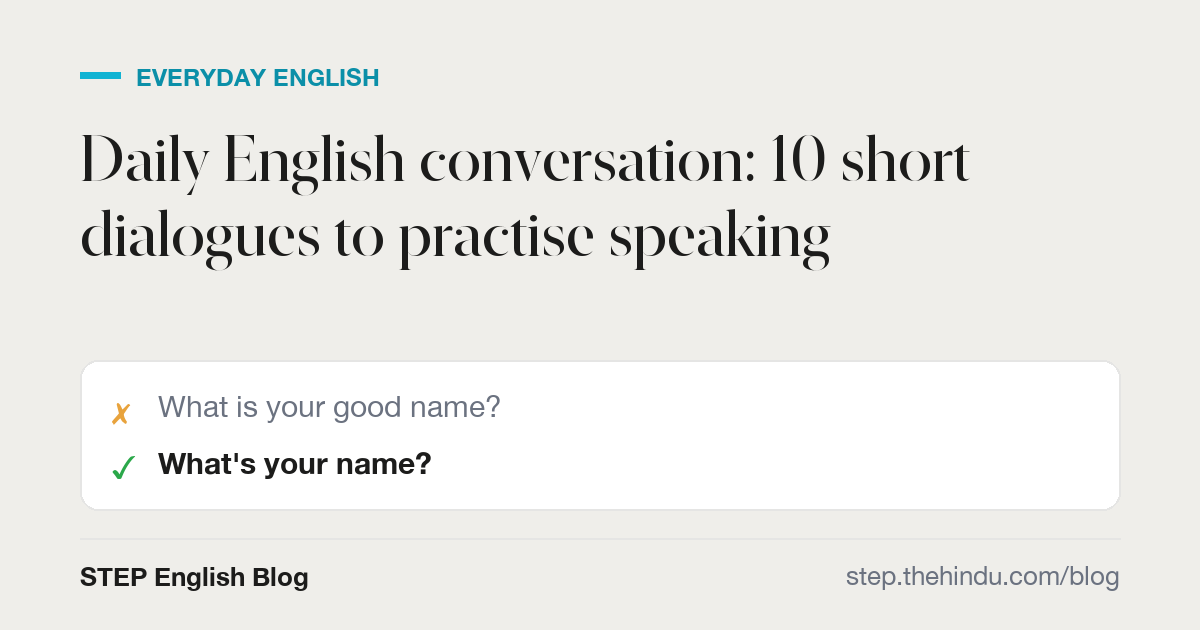
- ✗ What is your good name?
✓ What’s your name? (or: Sorry, I didn’t catch your name.) - ✗ We discussed about the delivery.
✓ We discussed the delivery. - ✗ I’ll reach to the shop by six.
✓ I’ll get to the shop by six. - ✗ Can you tell me where is the bus stand?
✓ Can you tell me where the bus stand is? - ✗ I’m looking forward to meet you.
✓ I’m looking forward to meeting you.
Practise the whole line aloud. Later, try it with a different shop, place or person.
Practice
Speak each missing line before reading the model answers. Then try the whole exchange with your own details.
1. Make a plan.
Friend: Are you free for lunch on Sunday?
You: _____ [Say you’re busy at lunch and suggest four.]
Friend: Four works. Where shall we meet?
You: _____ [Suggest a place.]
2. Check a delivery.
Agent: What seems to be the problem?
You: _____ [Explain that your parcel was due yesterday.]
Agent: It should come tomorrow.
You: _____ [Ask what time it will arrive.]
Model answers
- “I’m busy at lunch. Does four work for you?” Then, “Shall we meet outside the metro station?”
- “My parcel was due yesterday, but it hasn’t arrived.” Then, “Do you know what time it will arrive?”
Practising alone gets you started. A STEP coach can play the other person in any of these conversations and give you feedback as you speak.
Related: How to learn spoken English · Questions to ask a stranger · Indianisms: 12 examples and what to say instead