
Reviewed by Shailaja Ramesh
Vocabulary is a quarter of your IELTS Speaking score. But examiners don’t reward long or rare words for their own sake. They listen for everyday words used precisely, a few less common words and idioms used naturally, and whether you can say something another way when the right word doesn’t come.
Below: what examiners look for, whether to use idioms, the word combinations that trip up Indian candidates, how to paraphrase, and useful phrases for each part. There’s a practice set at the end.
What examiners look for
The Speaking test is marked on four criteria with equal weight: fluency and coherence, lexical resource (vocabulary), grammatical range and accuracy, and pronunciation. Here’s what the official band descriptors say about vocabulary at bands 6, 7 and 8, in plain words:
| Band | Vocabulary |
|---|---|
| 6 | Enough words to talk about topics at length. Some words are used wrongly, but the meaning is clear. You can usually explain something another way. |
| 7 | You use words flexibly across different topics. You use some less common words and idioms, and you know which words go together, though you make some mistakes. You paraphrase well. |
| 8 | A wide range of words, used easily and precisely on any topic. Less common words and idioms are used skilfully, with only occasional slips. |
The step from 6 to 7 isn’t about difficult words. It’s about choosing the right word, combining words naturally, and sounding like you’re talking, not reciting.
Should you use idioms?
Yes, if they sound natural and fit what you’re saying. The Speaking test is a conversation, so everyday idioms are fine. What doesn’t work is forcing in idioms you’ve memorised from a list. Examiners hear “it’s raining cats and dogs” and “a blessing in disguise” every day, often in the wrong place.
- ✗ Cooking is a piece of cake for me, and I am over the moon when I cook.
- ✓ I enjoy cooking. It’s how I switch off after work.
Idioms and phrases that sound natural in conversation:
| Say | Meaning | Example |
|---|---|---|
| I’m not a big fan of… | I don’t like… much | I’m not a big fan of horror films. |
| It’s not really my thing | I’m not interested in it | Gaming’s not really my thing. |
| every now and then | sometimes | Every now and then we order in. |
| off the top of my head | without checking | Off the top of my head, I’d say about twenty. |
| on the go | busy, moving around | I’m on the go all day, so I eat on the train. |
| a hidden gem | a good place few people know | There’s a hidden gem of a café near my office. |
| learn the hard way | learn from a bad experience | I learned the hard way to keep a spare charger. |
| cost a fortune | be very expensive | Flights at Diwali cost a fortune. |
One or two in a whole test is plenty. If you’re not sure an idiom fits, use a plain word instead.
Words that go together
Collocations are words that naturally go together, like heavy traffic or make a mistake. The band 7 descriptor mentions “an awareness of style and collocation”, and this is where many Indian candidates lose marks. These are common in Indian English but sound wrong to an examiner:
| ✗ Avoid | ✓ Say |
|---|---|
| give an exam | take an exam |
| do a mistake | make a mistake |
| high traffic | heavy traffic |
| strong rain | heavy rain |
| open the light | switch on the light |
| learn knowledge | gain knowledge |
| cousin brother | my cousin |
| do enjoyment | have fun, enjoy yourself |
Precise words instead of “very”
“Very good”, “very nice” and “very big” tell the examiner very little. A precise word says more:
| Instead of | Try |
|---|---|
| very good (film, book) | gripping, brilliant |
| very tasty | delicious |
| very tired | exhausted |
| very big | huge |
| very crowded | packed |
| very important | essential |
| very happy | delighted |
You don’t need to change every “very”. Swap one or two per answer for a word that says exactly what you mean.
When you don’t know a word: paraphrase
Every candidate forgets a word sometimes. What matters is what you do next. Stopping for a long time hurts your fluency. Describing the thing instead shows the examiner you can paraphrase, which the band descriptors reward.
- ✗ The time I take to… (long pause) … sorry, I forgot the word.
- ✓ It takes me an hour to get to the office, so I spend a lot of time on the train.
Phrases that help:
- What I mean is…
- It’s a kind of…
- I can’t think of the word, but it’s the thing you use to…
It also helps not to repeat the examiner’s words. If they ask Do you like reading?, try Yes, I’m a big reader rather than Yes, I like reading.
Useful phrases for each part
- Part 1: Mostly… · These days… · It depends. On weekdays…, but at weekends…
- Part 2: What I remember most is… · At the time, I felt… · Looking back…
- Part 3: I’d say… · Having said that… · I’d imagine… · Compared with…
More on each part in our posts on Part 1, Part 2 and Part 3. For words on common topics like home, work, food and travel, see our list of IELTS Speaking topics.
How to build vocabulary for Speaking
- Learn words in phrases, not lists. Learn heavy traffic, not just heavy.
- Collect words from things you enjoy in English: podcasts, YouTube, series. Note phrases people actually say.
- Use a new phrase the same day in a practice answer, out loud.
- Record yourself and listen for repeats. If you hear very, nice, good or thing five times, pick one to replace.
Our post on improving your vocabulary has more ways to do this.
Mistakes Indian candidates often make
- Saying “very very”. Use one precise word instead.
- Overusing fillers like basically and actually. A short pause is better than a filler in every sentence.
- Memorising word lists. Rare words used slightly wrongly cost more than simple words used well.
- Using formal written words in speech. Words like plethora and myriad sound odd in conversation:
- ✗ There are a plethora of eateries in my locality.
- ✓ There are lots of good places to eat near my home.
Practice
Improve these:
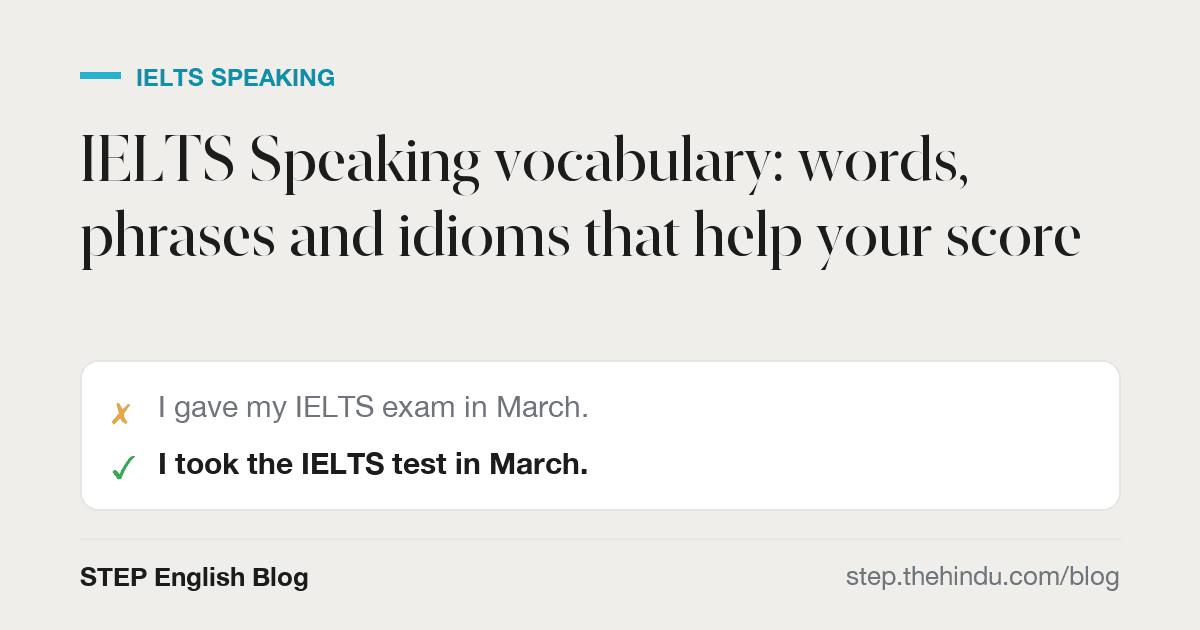
- I gave my IELTS exam in March.
- The traffic in Bengaluru is very high.
- My cousin brother is doing engineering.
- The food was very very tasty.
- I do a lot of mistakes in grammar.
Answers (one good version each): 1. I took the IELTS test in March. 2. The traffic in Bengaluru is really heavy. 3. My cousin is studying engineering. 4. The food was delicious. 5. I make a lot of grammar mistakes.
Then answer these out loud, using one phrase from this post in each answer: What do you do to relax? · Describe a place you like to eat. · Do you think people spend too much time on their phones?
Word lists are easy to find. Knowing which of your own words sound unnatural is harder, because you can’t hear it yourself. On STEP coach calls, you practise Parts 1, 2 and 3 with mock tests and get personal feedback on every answer, including the words you use.
Related: IELTS Speaking topics: 12 common themes with questions · IELTS Speaking Part 1: introduction, common questions and sample answers · How to improve your vocabulary: 10 ways that work · IELTS Speaking band descriptors: what bands 6, 7 and 8 mean