
Reviewed by Shailaja Ramesh
Part 2 of the IELTS Speaking test is the “long turn”. The examiner gives you a task card with a topic and a few points to cover. You get one minute to prepare, with a pencil and paper for notes, and then you speak for up to two minutes. The examiner stops you when the time is up and may ask one or two short questions about what you said. The whole part takes 3 to 4 minutes.
Below: what happens in Part 2, how to use your minute of preparation, a full sample answer, and the mistakes to avoid. There’s a practice card at the end.
What happens in Part 2
- The examiner gives you a task card, a pencil and paper.
- You have one minute to read the card and make notes.
- You speak on the topic. Aim to keep going for the full two minutes.
- The examiner stops you and may ask one or two follow-up questions.
Part 3 then follows, where the examiner asks broader questions linked to your Part 2 topic.
What a cue card looks like
Every card has the same shape: a topic, three or four points to include, and a final point that asks you to explain something.
Describe a teacher who influenced you.
You should say:
who the teacher was
what subject they taught
what they did that you remember
and explain why this teacher influenced you.
The last point matters most. It’s where you give reasons and feelings, which shows the range of your English.
How to use your one minute
- Choose a real example quickly. A true story is easier to tell in detail than an invented one.
- Write keywords, not sentences. One or two words per point is enough.
- Follow the order on the card, and save the “explain” point for the end.
Notes for the card above might look like this:
Mrs Rao · Class 9 maths · explain steps aloud · 11/40 test, extra help · now: explain reports at work
Sample answer
This answer takes about two minutes to say at a natural pace.
I’d like to talk about Mrs Rao, who taught me maths in Class 9 at my school in Coimbatore.
I joined that school in the middle of the year. Maths was my weakest subject, and to be honest, I was a bit scared of it. Mrs Rao was strict, but in a fair way. Instead of just giving us the answers, she made us explain each step out loud to the class. At first I hated it, because I was shy and I often got the steps wrong in front of everyone.
What I remember most is our first unit test. I scored 11 out of 40. I expected her to be angry, but she asked me to stay after class and went through every mistake with me. For the next month, she gave me ten minutes after school twice a week. In the final exam I scored 34 out of 40, which felt like a huge achievement at the time.
The reason she influenced me so much isn’t really about maths, though. She taught me that explaining something out loud is the best way to find out whether you actually understand it. I still do that today. Before I send a report at work, I explain the main points to a colleague, and I usually catch a mistake or two.
Looking back, she also showed me that being patient with someone can change how they see themselves. I went from thinking I was bad at maths to choosing it in Class 11. So I’m really grateful that she didn’t give up on me.
Why it works:
- It covers every point on the card, in order, and ends with the “explain” point.
- It tells one specific story, with details like the test score, instead of general praise.
- It uses past tenses consistently for the story and the present for what’s true now.
- Phrases like What I remember most is, The reason… is and Looking back link the ideas without sounding memorised.
Keep going for the full two minutes
If you run out of things to say, add one of these:
- A specific moment: What I remember most is…
- An example: To give you an example, …
- A feeling: At the time, I felt…
- Then and now: Looking back, … or These days, …
It’s fine if the examiner stops you mid-sentence. That’s better than finishing early and sitting in silence.
Common Part 2 topics
Cue cards change, so don’t memorise answers. A memorised talk rarely fits the exact card, and it tends to sound flat. Instead, practise with the kinds of topic that come up often:
| Type | Example topics |
|---|---|
| A person | a teacher who influenced you, a friend you admire, someone who helped you |
| A place | a place you’d like to visit, a quiet place you like to go |
| An object | a gift you received, something you bought and were pleased with |
| An event | a celebration you enjoyed, a time you were late, a time you learned something new |
| Media and habits | a book you read recently, an app you use often, a hobby you enjoy |
Prepare two or three stories that could fit several cards. A story about a helpful teacher, for example, also works for “someone who helped you” or “a time you learned something new”.
Mistakes Indian candidates often make
- Stopping after a minute. “That’s all” at 60 seconds leaves a minute of marks unused.
- Writing full sentences while preparing. You run out of time and end up reading.
- Mixing tenses in a story.
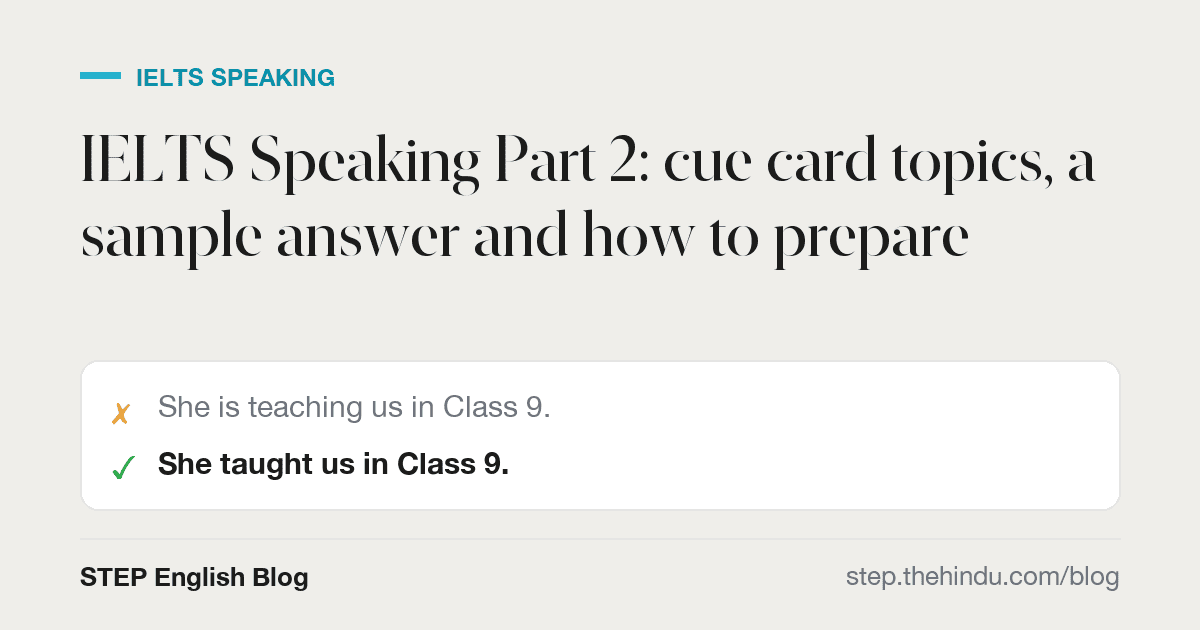
- ✗ She is teaching us in Class 9 and she gives extra classes.
- ✓ She taught us in Class 9 and gave us extra classes.
- Using rare words from lists. A word that’s slightly wrong costs more than a simple word used well.
- Skipping the “explain” point. It’s often the part that shows the most about your English.
Practice
Try this card with a timer: one minute to prepare, then two minutes to speak. Record yourself.
Describe a place you visited that you would like to go back to.
You should say:
where it is
when you went there
what you did there
and explain why you would like to go back.
When you listen back, check three things: did you cover every point, did you speak for the full two minutes, and did you keep the story in the past tense?
Then improve these:
- Last year I am going to Shimla with my family.
- The place was very very nice.
- That’s all. (said after 50 seconds)
Answers (one good version each): 1. Last year I went to Shimla with my family. 2. The place was beautiful, especially early in the morning. 3. Keep going: What I’d love to do next time is…
Practising alone helps you learn the format. Speaking for two minutes to a real examiner is different, and feedback on your answers makes the biggest difference. On STEP coach calls, you practise Parts 1, 2 and 3 with mock tests and get personal feedback on every answer.
Related: IELTS Speaking Part 1: introduction, common questions and sample answers · IELTS Speaking Part 3: question types, sample answers and useful phrases · IELTS Speaking topics: 12 common themes with questions · How to learn spoken English: 8 ways to practise